

THE MOLECULAR SCIENCE OF PLGG
Every tumor has a story written in its biology
Learning which molecular alteration is driving a child’s tumor can strengthen diagnosis and may reveal a treatment or clinical trial opportunity. It also shows researchers where important questions remain unanswered.

FROM DISCOVERY TO POSSIBILITY
Why tumor biology matters
Many pLGGs are driven by alterations in a connected network of genes. These alterations can disrupt the signals that normally regulate cell growth, allowing tumor cells to continue growing and surviving when they otherwise would not.
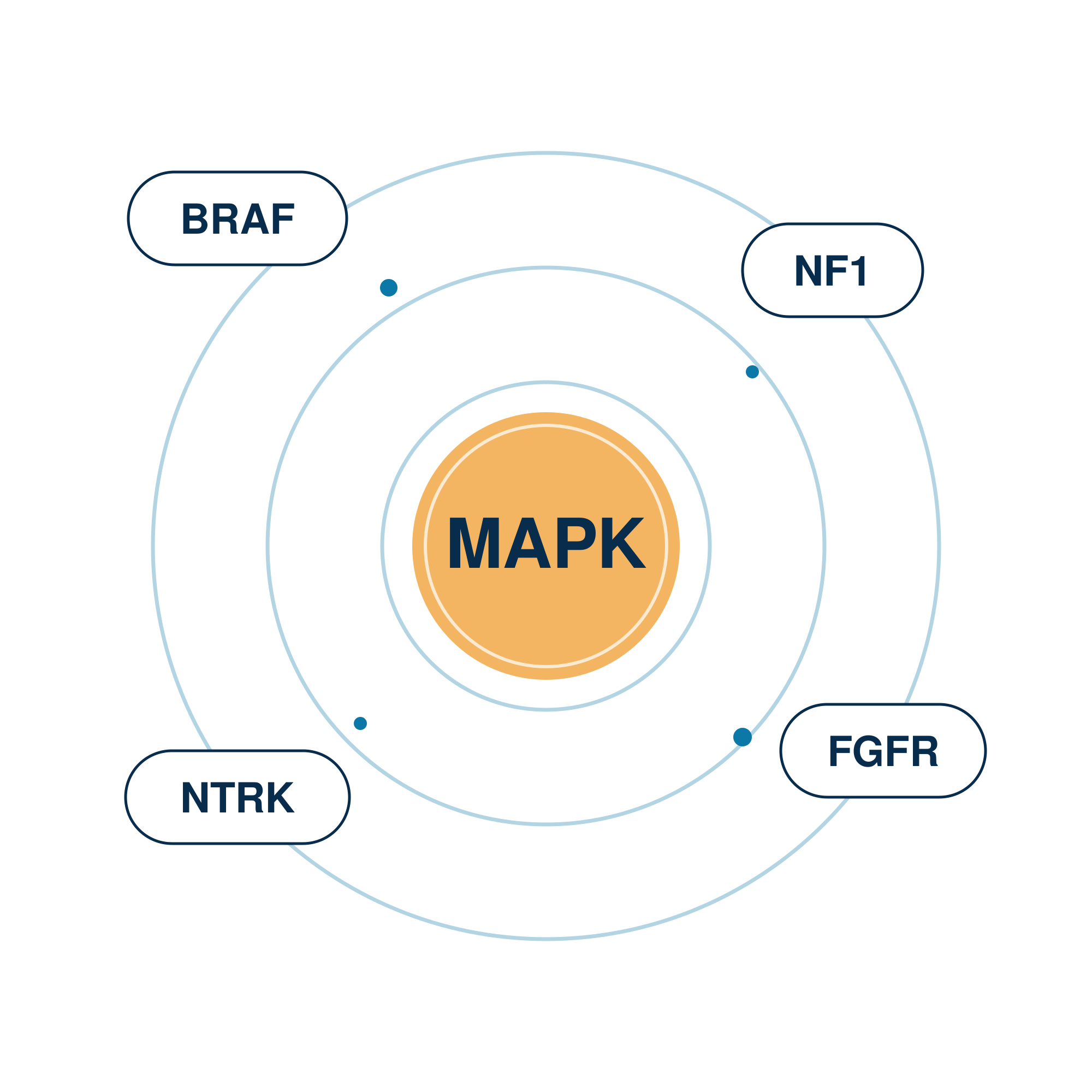
Most pLGGs involve activation of the MAPK signaling pathway. Common alterations affect BRAF or NF1, while other tumors involve FGFR1, NTRK, RAF1, ALK, ROS1, or other signaling proteins. Some pLGGs are driven by entirely different biology.
If the alteration driving a child’s tumor can be identified, the clinical team may be able to consider a medicine designed to interfere with that signal. Molecular information is one part of a larger clinical picture—not a treatment decision on its own.
EXPLORE THE MOLECULAR DRIVERS
One diagnosis. Different biology
Select each topic to learn what researchers know, what it may mean for treatment, and what still needs to be discovered.
BRAF is one of the most important molecular drivers identified in pLGG. It is a protein within the MAPK cell-growth pathway that normally helps control when cells grow. When BRAF becomes abnormally activated, it can continue sending growth signals to tumor cells.
-
A BRAF fusion occurs when BRAF joins with another gene, removing some of its normal controls. The most common example is KIAA1549::BRAF, although other rare fusions occur. These alterations are especially common in pilocytic astrocytomas.
In the United States, tovorafenib (Ojemda), a type II RAF inhibitor, received accelerated approval in 2024 for children six months and older with relapsed or refractory pLGG harboring a BRAF fusion or rearrangement, or a BRAF V600 mutation. Research continues into additional ways to target fusion-driven tumors safely and effectively.
-
BRAF V600E occurs in a smaller subset of pLGGs and is enriched in tumors including ganglioglioma and pleomorphic xanthoastrocytoma. It activates MAPK differently from a BRAF fusion—and that difference matters.
For children one year and older with BRAF V600E-mutated LGG who require systemic therapy, the FDA has approved dabrafenib plus trametinib. One medicine inhibits mutant BRAF; the other inhibits MEK downstream. Treatments designed for BRAF V600E should not be assumed to work for BRAF fusions, and some BRAF inhibitors can paradoxically activate signaling in fusion-driven tumors.
-
Neurofibromatosis type 1 is a genetic condition caused by a germline alteration in the NF1 gene, which normally helps regulate RAS/MAPK signaling. The alteration may be inherited or arise as a new genetic change. Children with NF1 have an increased risk of gliomas, particularly those involving the optic pathways.
MEK inhibitors—including selumetinib, trametinib, and binimetinib—have been studied in NF1-associated and sporadic pLGG. Selumetinib has shown activity in children with NF1-associated and sporadic disease, including tumors that cannot be safely removed.
A molecular diagnosis does not automatically mean a child needs targeted therapy. Decisions for NF1-associated gliomas are individualized with an expert medical team.
-
Some pLGGs contain alterations involving FGFR1, FGFR2, or FGFR3. These changes can activate signaling that promotes tumor growth, including the MAPK and PI3K/mTOR pathways.
FGFR inhibitors such as erdafitinib, pemigatinib, and futibatinib have been developed, but they are not broadly FDA-approved for pLGG based solely on an FGFR alteration. Their role in pediatric glioma remains an area of clinical research. Whether an alteration may be targetable depends on its exact type and the child’s clinical circumstances.
-
Some pediatric gliomas contain fusions involving NTRK1, NTRK2, or NTRK3. Although uncommon in pLGG, these fusions are important because they can activate TRK proteins that drive tumor growth—and selective TRK inhibitors are available.
Larotrectinib selectively inhibits TRK, while entrectinib targets TRK as well as ROS1 and ALK. Both have demonstrated activity in tumors harboring NTRK fusions. Tumor-agnostic approvals illustrate why comprehensive molecular testing can matter: a rare finding may reveal an opportunity that is not apparent from the tumor’s appearance under a microscope.
-
ALK and ROS1 alterations are uncommon in pLGG but have been identified across pediatric brain tumors. Targeted inhibitors have shown activity in cancers driven by these alterations, but their use in pLGG depends on the exact finding, the clinical circumstances, and the availability of an appropriate clinical trial or treatment pathway.
Because these alterations are rare, collaborative research and clinical trials are particularly important for determining which children are most likely to benefit.
-
Not every pLGG is driven exclusively by MAPK. PI3K/mTOR is another signaling network involved in cell growth, metabolism, and survival. The MAPK and mTOR pathways can interact, and some pLGGs show activation of both.
Drugs that inhibit mTOR, including everolimus, have been studied in pediatric low-grade gliomas and related tumors. The central research challenge is determining which tumors truly depend on this pathway and which children are most likely to benefit.
-
A subset of pediatric-type diffuse low-grade gliomas contains alterations involving MYB or MYBL1. Unlike BRAF, these proteins are transcription factors rather than conventional druggable kinases, making them especially challenging therapeutic targets.
Researchers are working to understand how these alterations drive tumor formation, what other proteins and pathways the tumors depend on, whether those dependencies can be targeted, and why these tumors can behave differently from other pLGGs.
Sometimes the most important discovery is identifying a target that medicine does not yet know how to treat. This is where investment in basic and translational research can change the future.
A QUESTION TO ASK THE CARE TEAM
Has molecular testing been considered?
Molecular testing may help refine a diagnosis and identify relevant treatments or clinical trials. The appropriate test, tissue requirements, timing, and interpretation depend on the individual child and should be discussed with specialists experienced in pediatric brain tumors.
Important: A molecular alteration alone does not determine treatment. Tumor location, symptoms, age, prior care, expected benefits, potential side effects, and the child’s goals all matter.
WHY RESEARCH MUST CONTINUE
Discovery creates possibility
Some molecular discoveries already help guide treatment. Others reveal biological targets that medicine does not yet know how to address. Both are essential.
By supporting research across Boston and Heidelberg, Richi pLGG Cure aims to accelerate the journey from understanding what drives these tumors to developing more precise, effective, and less burdensome treatments for children.
Trusted sources and further reading
NATIONAL CANCER INSTITUTE
U.S. FOOD AND DRUG ADMINISTRATION
U.S. FOOD AND DRUG ADMINISTRATION